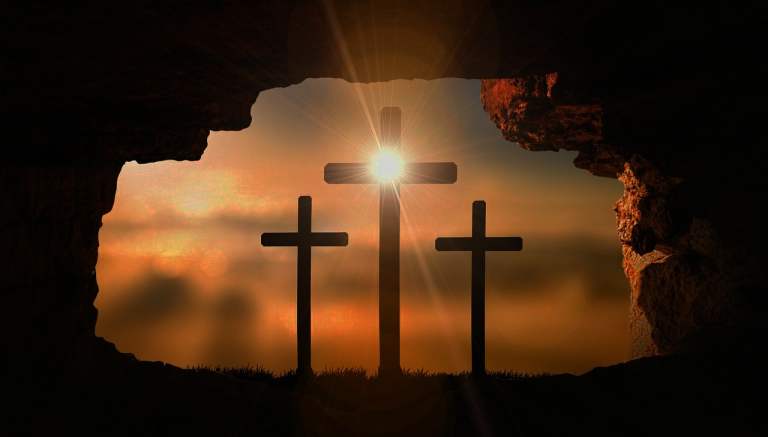
“When Christ calls a man, he bids him come and die.”
This quote is from the book, The Cost of Discipleship written by Dietrich Bonhoeffer a theologian killed by the Hittler regime. His words echo Jesus’ words in Luke 9:51–62.
Even when we are at the beginning of Pentecost, -which is the season we celebrate the empowerment of the disciples to go and proclaim the Good News- today’s scripture is more related to Lent, when our Lord is getting ready to die. In today’s scripture Jesus is on His way to Jerusalem with his crucifixion in mind. We know this because of the words Luke uses, “he set his face to go to Jerusalem” or “Jesus resolutely set out for Jerusalem.” Meaning he was ready to face what was waiting ahead. As He sets His face toward the cross, Luke shares with us a story with two moments, one involving the long-time followers and the other about some men being invited by Jesus to become followers and we see two different attitudes.
From this point forward in their ministry, the disciples will realize that following Jesus will become more risky, more costly, and more demanding. Luke places before us this morning two kinds of followers:
The first one is represented by James and John who have been with Jesus for three and a half years but still misunderstand the heart of the mission. And the second one is represented by the “potential” followers, people who are invited to follow but offer various excuses for not being able to.
Jesus uses both groups to teach us that following Him is not about status, power, comfort, or control, but about surrender.
When John and James realized the Samaritans did not welcome Jesus, they asked Jesus’s permission to call fire down from heaven to destroy them. Even when Luke does not say it, they had in mind what Elijah did with the soldiers sent by king Ahaziah, described in 2 Kings 1. Let us not forget also that at the beginning of chapter 9, Jesus sent the disciples to proclaim the Kingdom of God and gave them power and authority to drive out all demons and to cure diseases. That little taste of power they had did not do good to them. These long-time followers still have to understand that God’s power was given to them not to bring revenge or punishing other people -even if they were Samaritans-, but to do God’s good. Jesus rebukes them for their attitude. Some modern disciples still believe that the power they have received by God is to impose our way of living and to destroy those who live in a different way. They have a lot to learn.
Next, Jesus encounters three men. The first one offers himself to follow Jesus but was not ready. He had things to do. The other two are invited by Jesus, but both had excuses.
In Jesus’ times as well as in ours many people are drawn to Jesus’ miracles, wisdom, and love. But when Jesus speaks about the cost of following Him, they reject the call. Bonhoeffer called this distinction the difference between cheap grace and costly grace. According to him those followers who practice cheap grace, or grace without commitment expects forgiveness without repentance, baptism without discipline and communion without confession. But costly grace -says Bonhoffer- calls all who follow Jesus to commit to his will and leave everything and follow him. It had never been easy to follow Jesus the way he expects us to folllow.
From Jesus, who was disciple of God’s Kingdom, we can determine that discipleship requires determination. Verses 51–56 describe our Lord setting his face to go to Jerusalem even when he knew Jerusalem meant suffering and death, He was resolute. He was not distracted by the rejection or resistance put by the Samaritans. When the Samaritan village refused Him, His disciples wanted revenge, but Jesus rebuked them. This reminds us that our mission as his disciples is not a mission of violence or comfort, but of holy purpose.
In his Book, Bonhoeffer writes: “The disciple is dragged out of his relative security into the absolute insecurity… out of the safe confines of the law into complete freedom of decision and action.” True discipleship demands sacrifice, undivided loyalty, and full submission. That is clear in verses 57-58, “Foxes have holes, and birds of the air have nests, but the Son of Man has nowhere to lay his head.”
In an age of social media, when following takes no more than a click, we can easily forget that to follow Jesus requires more than click and scrolling, and it will cost something. Those men invited by Jesus to follow had valid reason for not to follow immediately. Now naturally, Jesus could let them do these things that feel so crucial and necessary. Any of us here would also want to bury our parents or tell our people at home that we are leaving. However, the reason these stories were recorded Luke was to show that this following Jesus invites us to, is costly and time sensitive. The harvest is plentiful, and the laborers are few says Matthew 9:37.
The inevitable question is: Is this suffering part of God’s plan?
Suffering is part of the fallen world and the spiritual conflict within, but God’s final plan is the removal of all suffering and evil. God’s intensions are for his people to live together in harmony. The suffering Jesus’ follower endure is the result of the conflict between good and evil we are involved. When we as followers face sin in any of its forms and manifestations it is inevitable not to be reviled or persecuted; when we, because of who we are, do not conform to the pattern of this world, we will face suffering. When that happen remember Matthew 5:11–12 – “Blessed are you when others revile you and persecute you…for so they persecuted the prophets who were before you.” Acts 5:41 tells how the apostles rejoiced that they were counted worthy to suffer dishonor for the name of Jesus.
Remember, suffering for doing God’s will often become a testimony—both to the faith of the believer and to the grace and power of God. Suffering is not arbitrarily intended by Jesus, but it is allowed as part of His redemptive plan—for growth, witness, and union with Him. It is not meaningless, and it is not outside of His control.
Any of Jesus’ followers who will raise his or her voice against a world who promote and enjoy war to remind this world that war is a sin and that we serve the Prince of Peace will face rejection, persecution and suffering; any follower of Jesus who will stand and defend those who Jesus calls my little ones, will face rejection, persecution and suffering; any Christian who speak against the injustice of this world and promote and advocate for the justice of God, will automatically face rejection, persecution and suffering. This suffering helps believers deepen their fellowship with Jesus, who suffered for them. It shapes them into His likeness.
Brothers and sisters, following Jesus is not always easy. He never promised us comfort or ease—but He did promise His presence, His power, and His purpose. He told us there would be a cross to carry, suffering to endure, and a world that would sometimes reject us. And yet, He also promised that none of it would be in vain.
When we suffer for Christ, when we suffer for doing good, the good he wants us to do, we do not suffer alone—and we do not suffer without hope. Our trials shape us, our pain becomes a testimony, and our perseverance shines as light in the darkness. So, what do we do about this truth? We keep going. We press on. We don’t look back.
As Jesus said in Luke 9:62, “No one who puts a hand to the plow and looks back is fit for service in the kingdom of God.” Once we say yes to Him, there’s no turning back. The kingdom of God is too glorious, the mission too urgent, and the Savior too worthy for us to quit when the road gets rough.
Let us then fix our eyes on Jesus. Let us trust Him in our suffering, follow Him with endurance, and serve Him without hesitation—no matter the cost.
Because the One who walked the road to the cross also walked out of the tomb. And He walks with us still. I will finish with Bonhoeffer two quotes.
“Being a Christan is less about cautiously avoiding sin than about courageously and actively doing God’s will.” “Christianity without discipleship is always Christianity without Christ.”